ELBO-T2IAlign: A Generic ELBO-Based Method for Calibrating Pixel-level Text-Image Alignment in Diffusion Models


Accepted to IEEE Transactions on Image Processing (TIP), 2026
CCF-A
Diffusion models excel at image generation. Recent studies have shown that these models not only generate high quality images but also encode text-image alignment information through attention maps or loss functions. This information is valuable for various downstream tasks, including segmentation, text-guided image editing, and compositional image generation. However, current methods heavily rely on the assumption of perfect text-image alignment in diffusion models, which is not the case.
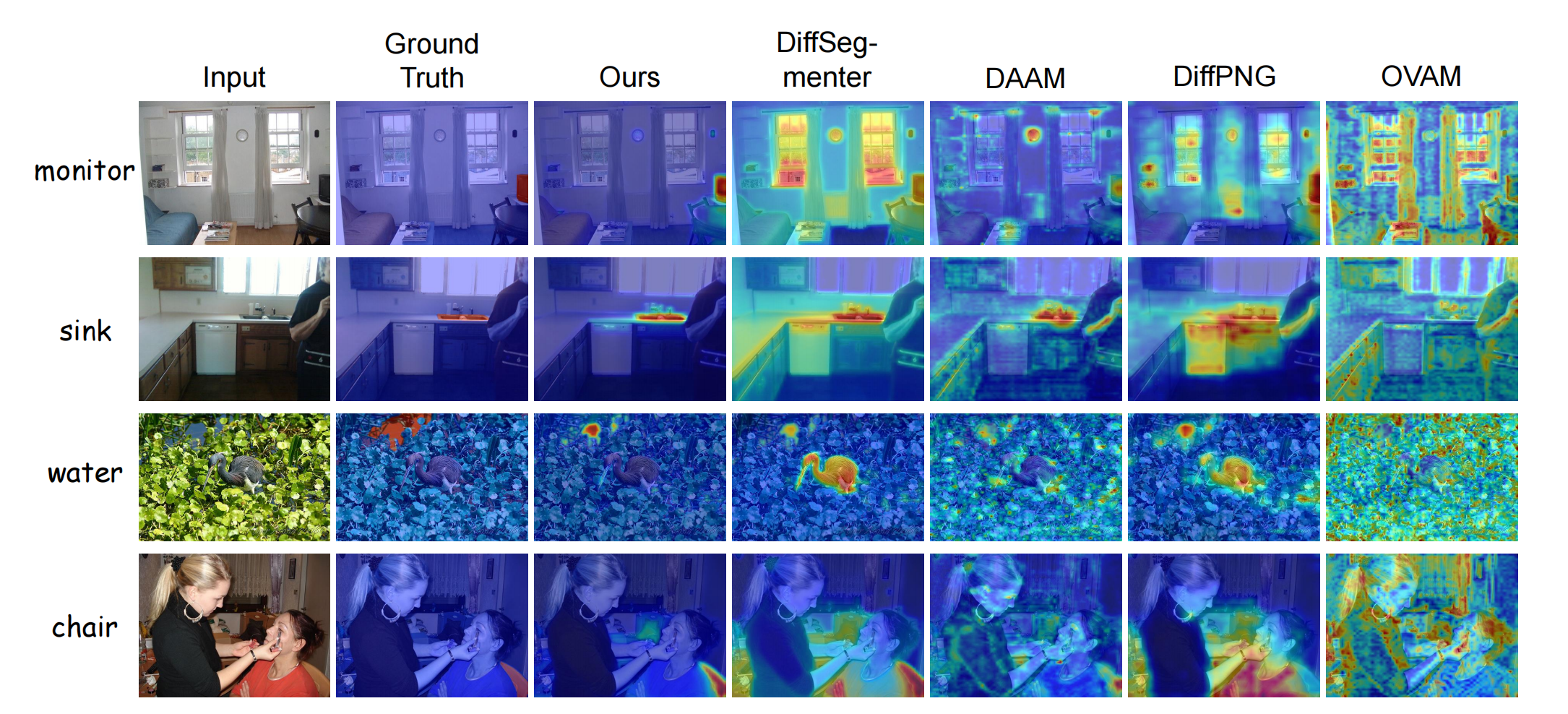
In this paper, we propose using zero-shot referring image segmentation as a proxy task to evaluate the pixel-level image and class-level text alignment of popular diffusion models. We conduct an in-depth analysis of pixel-text misalignment in diffusion models from the perspective of training data bias. We find that misalignment occurs in images with small-sized, occluded, or rare object classes. Therefore, we propose ELBO-T2IAlign—a simple yet effective method to calibrate pixel-text alignment in diffusion models based on the evidence lower bound (ELBO) of likelihood. ELBO-T2IAlign is training-free and generic: it requires no additional annotations, model retraining, or architectural modifications, and it can be directly applied to different diffusion backbones. Extensive experiments on zero-shot referring image segmentation, text-guided image editing, and compositional image generation verify that the proposed calibration improves pixel-text alignment across complementary downstream tasks.
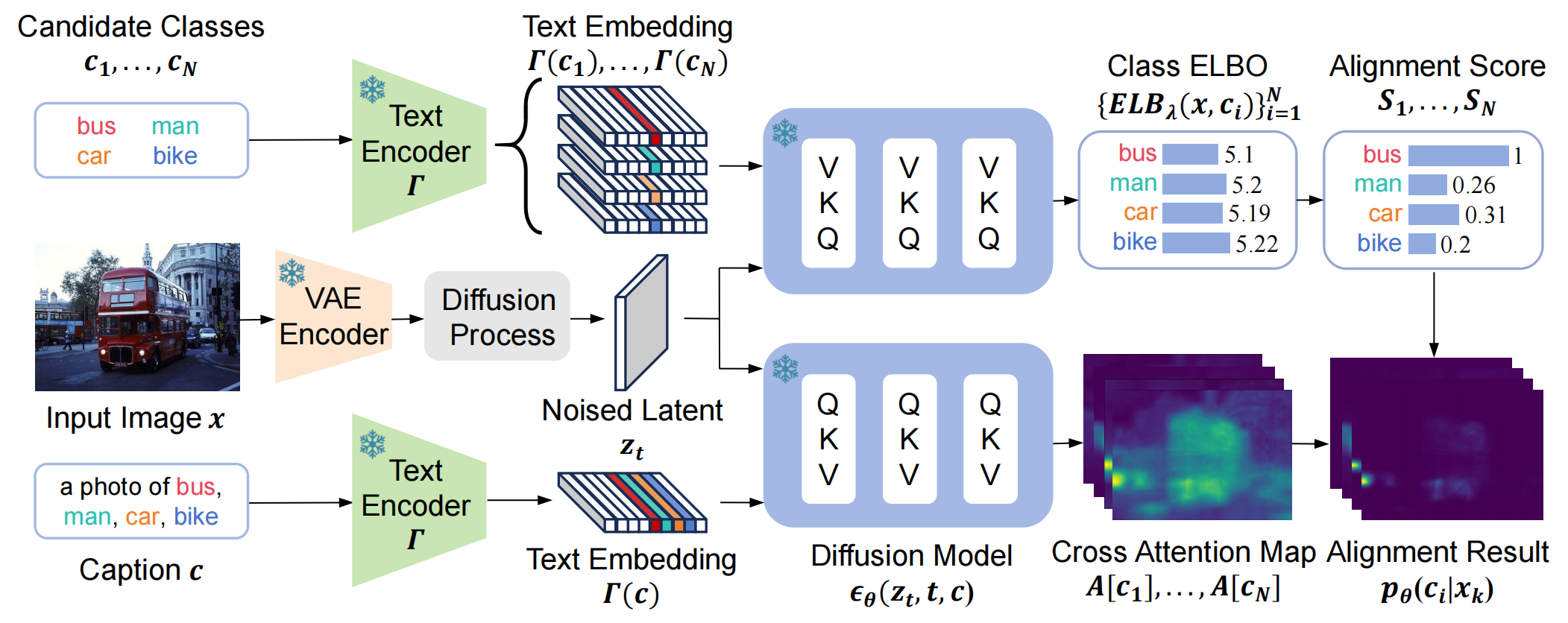
Pipeline of ELBO-T2IAlign. Given a pre-trained frozen diffusion model, we approximate the rough pixel-text alignment through cross-attention map. Then, we compute the ELBO of likelihood \( p_\theta(x|c_i) \) of each class \( c_i \). We define an alignment score based on ELBO, which is used for calibrate the cross-attention map. Segmentation masks are generated by applying threshold to \( p_\theta(c_i|x_k) \).
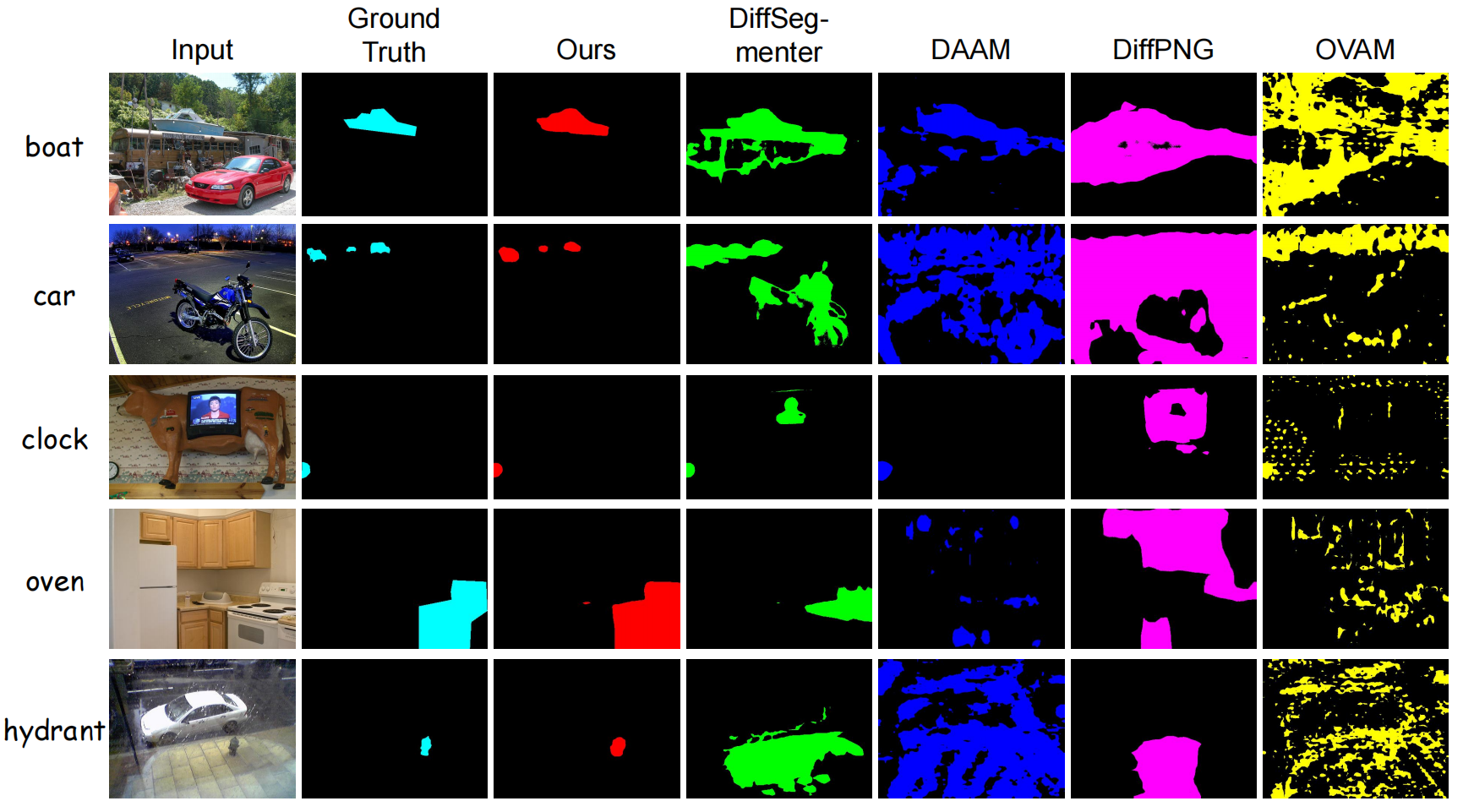
Here are some segmentation results for zero-shot referring image segmentation. We can see that our proposed ELBO-T2IAlign can achieve better segmentation results than previous methods.
For editing, our method extracts entities from source text to generate heatmaps, which are scaled and used to replace target cross-attention maps, enabling more accurate generation and editing.
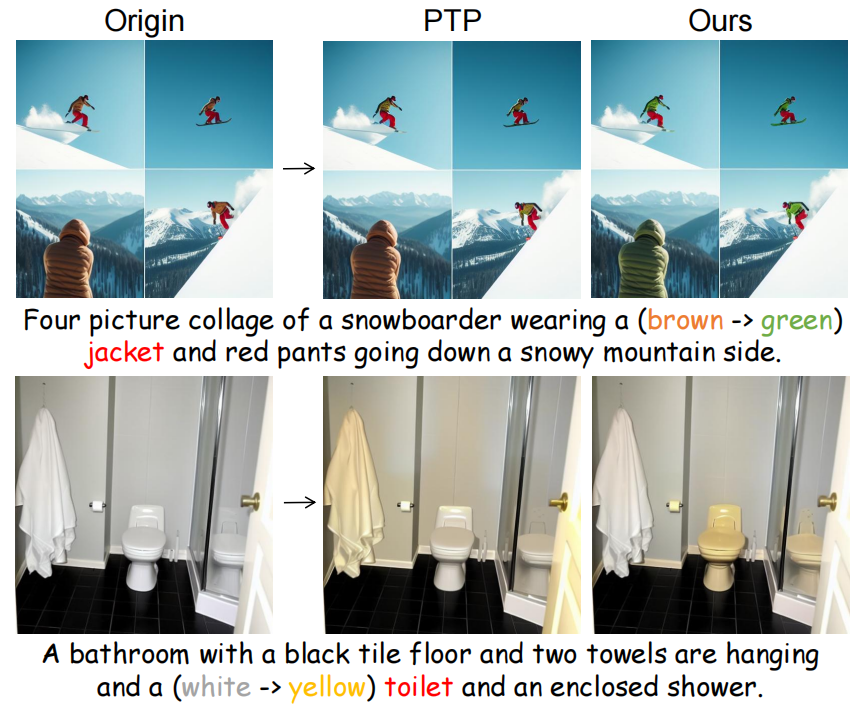
Comparison results of image editing based on PTP
before and after calibration
using our ELBO-T2IAlign.
For generation, our method balances the semantics of entities during generation using alignment scores to enhance text-image consistency.
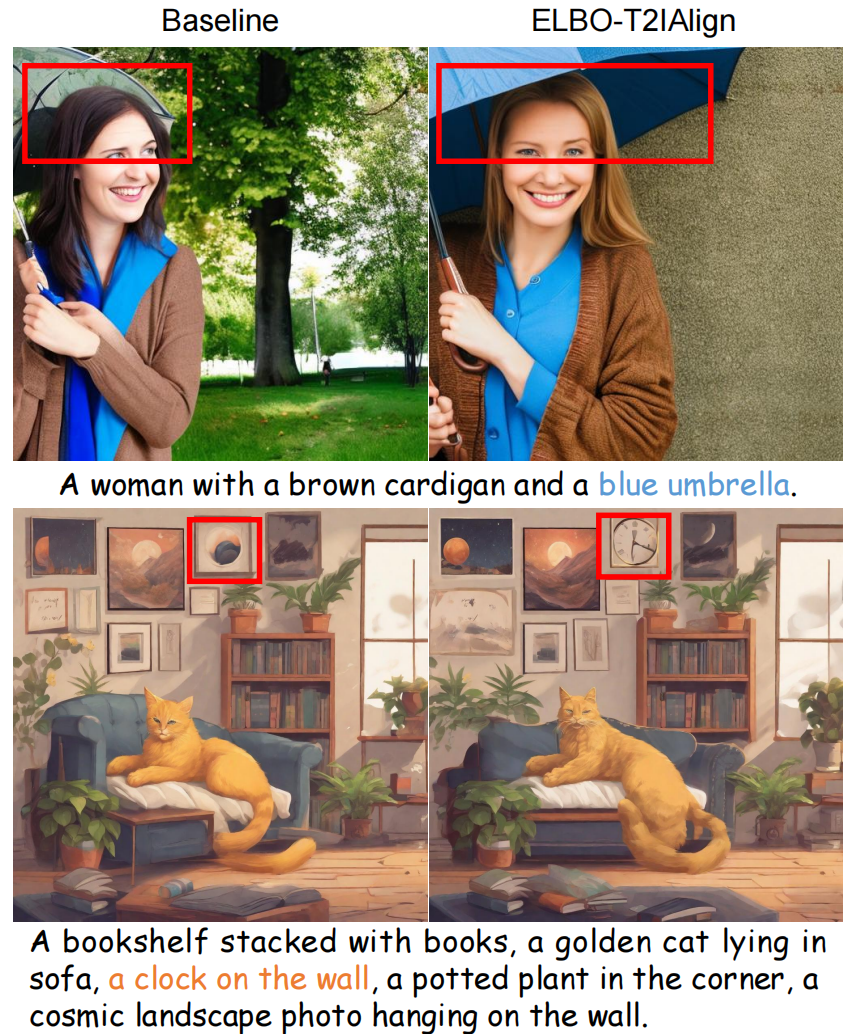
Qualitative compositional generation results of before and after
calibration
using our ELBO-T2IAlign.
@article{zhou2025elbo,
      title={ELBO-T2IAlign: A Generic ELBO-Based Method for Calibrating Pixel-level Text-Image Alignment in Diffusion Models},
      author={Zhou, Qin and Zhang, Zhiyang and Wang, Jinglong and Li, Xiaobin and Zhang, Jing and Yu, Qian and Sheng, Lu and
      Xu, Dong},
      journal={arXiv preprint arXiv:2506.09740},
      year={2025}
      }